
If your vehicle displays fault codes such as B009612 or B009615, accompanied by messages like:
“The crash sensor has a malfunction. There is a short to positive or an open circuit,”
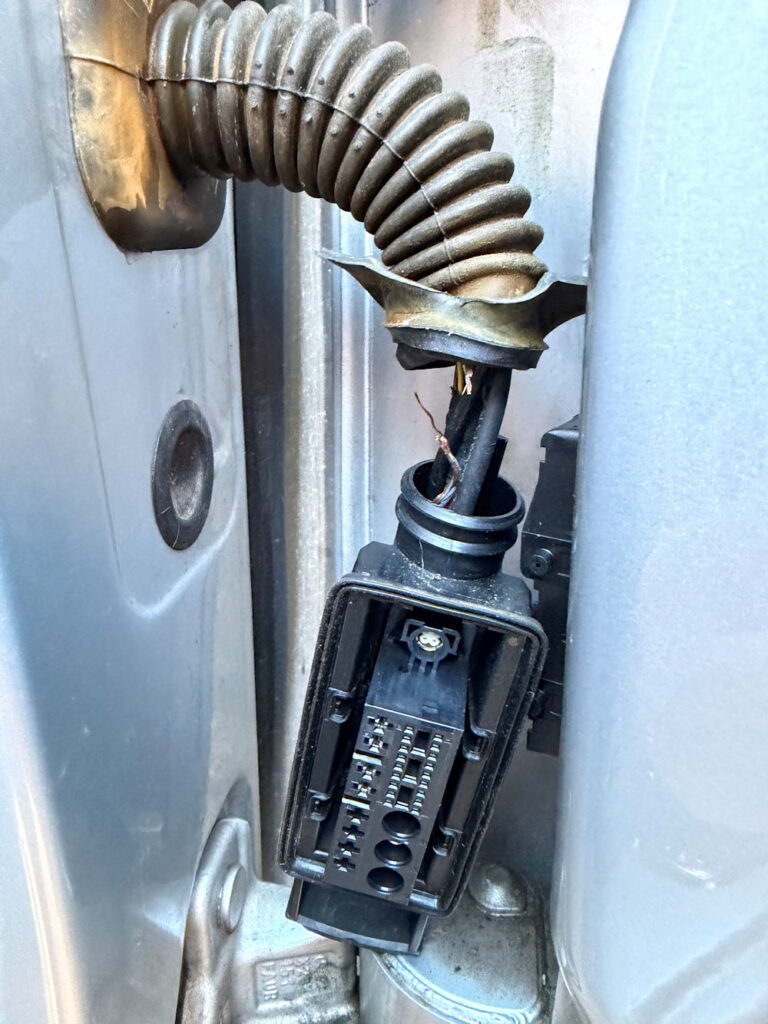
and replacing the crash sensor itself hasn’t resolved the issue, the problem may lie deeper- specifically within the door hinge wiring loom.
Important Safety Reminder:
Before working on any part of the airbag or crash sensor system, always disconnect the vehicle’s battery and wait for a recommended period (usually 10-15 minutes) to ensure the system is fully de-energized. This reduces the risk of accidental airbag deployment or electrical shock.
Why Do These Faults Occur?
Since the early 2000s, many manufacturers, including Mercedes-Benz, have used environmentally friendly thermoplastics for wiring loom insulation. Although these materials are more eco-conscious, they tend to be less durable and more prone to damage over time, especially in areas subjected to repeated stress, flexing, or temperature variations.
Key Point:
The wiring loom in the door hinge area is particularly vulnerable because it flexes every time the door opens and closes. Over years, this continual movement can cause the insulation to crack, exposing the conductors inside.
Diagnosing the Issue
- Inspect the Connector:
The connector on the door side features a slide-on bottom release mechanism. To disconnect it:- Carefully pull the slide out with equal force on both sides.
- This step can be tricky and requires patience to avoid damaging the connector or the wiring.
- Visual Inspection:
Once disconnected, gently pull back the rubber weather protection boot to expose the wiring loom inside the door. - Identify the Crash Sensor Wire:
The crash sensor wiring is typically a very thin brown wire with a white line (inside the door, it may be a brown wire with a green line).- Look closely for visible damage, cuts, or breaks in the wiring insulation.
- A break or exposed conductor indicates the cause of the fault.
Repairing the Wiring
Repairing damaged wiring in such a confined space can be delicate but achievable:
- Expose the Conductor:
Carefully strip back the insulation on both sides of the broken wire, exposing a small section of the copper conductor. - Prepare the Repair Wire:
- Use a piece of heat-shrink tubing that is long enough to cover the repair joint.
- Cut a small segment of copper wire of similar gauge to the original wiring.
- Solder the Connection:
- Tin both the exposed wire ends and the repair wire with a fine soldering iron.
- Carefully solder the wires together, ensuring a solid electrical connection without excess solder that could cause shorts.
- Insulate and Protect:
- Slide the heat-shrink tubing over the repaired joint.
- Use a heat gun or lighter to carefully shrink the tubing, creating a secure, insulated repair.
Additional Tips
- Work Carefully: The wiring in door hinges is fragile; take your time to avoid causing further damage.
- Use Appropriate Tools: Fine-tipped soldering iron, small wire cutters, and heat-shrink tubing are essential.
- Test After Repair: Once reassembled, reconnect the battery and perform a system check to ensure the fault has been resolved.